


Views: 0 Author: Site Editor Publish Time: 2026-06-17 Origin: Site


Scaling up to continuous 24/7 mass production fundamentally shifts factory bottlenecks. Moving raw materials into the facility is rarely the main issue anymore. Instead, finishing and cutting processes often dictate your maximum throughput. Standard commercial cutters simply cannot handle continuous multi-shift operations. They degrade in accuracy rapidly under stress. They also require excessive maintenance when pushed beyond light-duty cycles. Manufacturers quickly face thermal throttling, severe vibration drift, and ruined substrates.
This article serves as a pragmatic, criteria-driven guide. We will help you evaluate and shortlist industrial-grade equipment correctly. You will learn exactly what makes a machine capable of uninterrupted bulk cutting. We focus heavily on applications spanning packaging, commercial print, and heavy industrial manufacturing. Read on to discover the specific hardware requirements, software integrations, and mechanical tolerances necessary to sustain true round-the-clock production safely and efficiently.
Durability over peak speed: True 24/7 operation requires industrial-grade servo motors, active cooling, and welded steel frames to prevent thermal throttling and vibration drift.
TCO dictates ROI: The initial capital expenditure often accounts for less than 50% of the Total Cost of Ownership; consumables (blades, router bits) and unplanned downtime drive long-term costs.
Automation is mandatory: For mass production, automated material handling (conveyors, robotic arms, pallet loaders) is just as critical as the cutting head itself.
Software integration validates the hardware: A machine's value is capped by its ability to ingest nested CAD files from existing ERP/MIS workflows without manual prepress intervention.
You cannot simply run a standard cutting table longer to achieve mass production. True heavy-duty performance requires fundamental differences in physical architecture and mechanical design. We must look past theoretical top speeds and examine the underlying hardware.
Continuous high-speed routing and oscillating create massive kinetic energy. Standard aluminum extrusion frames flex under these forces. This microscopic flexion ruins edge quality over time. A proper industrial machine relies on heavy welded steel frames or aerospace-grade cast aluminum gantries. These dense materials absorb microscopic vibrations. They keep the cutting head perfectly stable during rapid directional changes. When you process dense materials like MDF or thick acrylics, structural mass prevents the resonance that causes tool chatter.
The motors moving the gantry dictate both speed and reliability. Many entry-level machines use open-loop stepper motors. Steppers lose synchronization, drop steps, and run extremely hot during continuous shifts. You must insist on industrial AC servo motors.
AC servos provide closed-loop feedback. They constantly check their exact position thousands of times per second. Furthermore, multi-shift runs generate significant heat. Active thermal management systems become mandatory. Liquid cooling loops or robust forced-air heatsinks prevent these drive systems from overheating. Without active cooling, thermal throttling will force your machine to slow down to protect itself.
Comparison Chart: Drive System Performance in 24/7 Environments | ||
Feature | Standard Stepper Motors | Industrial AC Servo Motors |
|---|---|---|
Feedback Loop | Open-loop (Blind positioning) | Closed-loop (Continuous position tracking) |
Heat Generation | High (Often requires breaks) | Low to Moderate (Designed for continuous duty) |
High-Speed Torque | Drops off significantly at high speeds | Maintains consistent torque across speeds |
Vibration Profile | High resonance at lower speeds | Extremely smooth operation |
Material stability directly impacts yield. If a substrate shifts mid-cut, you lose the entire sheet. Dynamic, multi-zone vacuum tables eliminate the need for manual taping or clamping. Heavy-duty tables divide the bed into independent matrices. The machine intelligently concentrates suction only where the material lies. It shuts off empty zones automatically. High-capacity regenerative blowers or rotary vane pumps power these systems. They generate enough negative pressure to hold down warped corrugated boards securely.
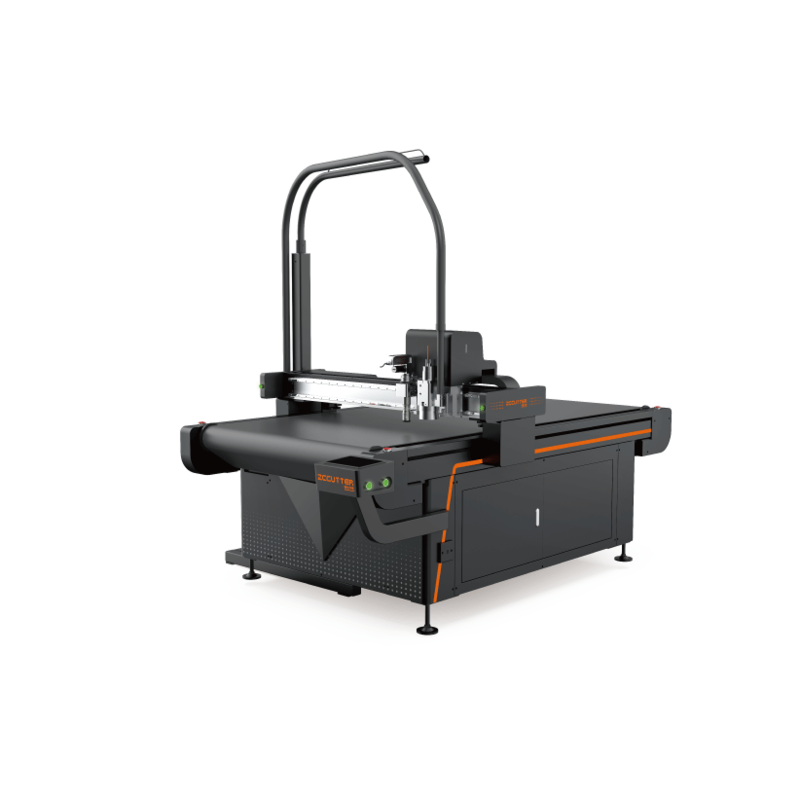
Evaluating hardware requires linking specific mechanical features to your desired production outcomes. A specification sheet only matters if it solves a real-world manufacturing bottleneck.
Every machine cuts accurately on its first day. The real test is unit number 1,000. You face a constant trade-off between speed and accuracy. Pushing a machine to its velocity limit often introduces corner-rounding or dimensional drift. To prevent this, focus on the transmission mechanisms.
Belt drives stretch and degrade. Heavy-duty systems utilize helical rack-and-pinion transmissions paired with linear guide rails. These hardened steel components maintain sub-millimeter tolerances permanently. When you invest in a Heavy-Duty Digital Cutting Machine, you expect it to perform identically across years of service. Linear guides ensure the gantry glides flawlessly, keeping toolpaths perfectly true.
Mass production rarely involves just one material. You might cut foam in the morning and route solid plastics by the afternoon. Swapping tool heads manually kills productivity.
Look for multi-tool heads capable of holding oscillating knives, drag knives, creasing wheels, and routers simultaneously. Furthermore, manual calibration introduces human error. Automatic Tool Depth (ATD) sensors measure the exact length of a new blade instantly. They adjust the Z-axis parameters without operator guesswork.
Camera-based registration systems (like CCD cameras) are equally crucial. Printed graphics often stretch or warp during the pressing phase. A CCD camera scans registration marks on the substrate. The software then dynamically distorts the digital cut path to match the physical print flawlessly.
A cutting head moving at two meters per second is useless if it sits idle waiting for material. The load and unload cycle represents the largest efficiency drain in digital cutting. True mass production demands robust automated handling.
Evaluate handling systems using this prioritized integration sequence:
Continuous Roll-to-Roll Feeders: Ideal for textiles, vinyl, and flexible composites. They pull material precisely using tension-controlled pinch rollers.
Board Feeders and Pallet Loaders: Essential for rigid substrates like corrugated plastic and foam board. Suction cups lift individual sheets from a bulk pallet onto the cutting bed.
Conveyor Extensions: These allow the machine to cut in the middle zone while simultaneously offloading finished pieces at the front and pulling fresh material from the rear.
Robotic Pick-and-Place Arms: The ultimate end-of-line automation. They sort and stack finished parts onto specific outbound pallets automatically.
Hardware provides the muscle, but software serves as the brain. An isolated machine creates a massive bottleneck in data processing. We must integrate the cutting table seamlessly into the wider factory ecosystem.
Manual prepress intervention destroys efficiency. Operators should not spend hours preparing files. The machine's native software must accept industry-standard structural design files natively. Compatibility with ArtiosCAD, AutoCAD, and Adobe Illustrator is non-negotiable. Furthermore, seamless RIP (Raster Image Processor) software integration allows barcode-driven workflows. The operator simply scans a barcode on the printed sheet. The machine automatically retrieves the correct cut file from the server and begins processing.
Substrate waste eats directly into your profit margins. Advanced nesting algorithms analyze complex vector shapes. They rotate and interlock these shapes to maximize material usage.
True Shape Nesting: Moves beyond simple bounding boxes. It places smaller parts inside the negative space of larger parts.
Defect Avoidance: Premium software allows operators to mark flaws on a leather hide or wood sheet. The algorithm automatically nests parts around these defects.
Common Line Cutting: Merges the shared edges of identical parts. The machine makes one cut instead of two, saving time and extending blade life.
Operating heavy machinery around the clock introduces serious safety liabilities. Fast-moving gantries can cause severe injuries. Industrial safety features are strictly regulated by OSHA in the US and CE directives in Europe.
Ensure the machine includes active light curtains. These invisible infrared barriers surround the cutting zone. If an operator breaks the beam, the machine halts instantly. Laser bumpers mounted directly on the gantry detect obstacles in the travel path. Redundant emergency stop relays must be easily accessible from all four corners of the machine. Do not compromise on compliance.
Even the best equipment encounters challenges when running continuously. Anticipating these specific failure modes separates successful deployments from frustrating ones. We must address the physical realities of 24/7 manufacturing.
Holding down solid acrylic is straightforward. Holding down highly porous materials presents a massive challenge. Corrugated cardboard and open-cell foams allow air to pass directly through them. This causes vacuum bleed-off, reducing overall hold-down force.
When cutting thousands of small, intricate parts, the vacuum escapes through the newly cut channels. The parts then shift, causing jams and collisions. To mitigate this, operators must utilize thin, breathable underlay mats. High-flow vacuum pumps, rather than high-pressure ones, perform better with porous materials. You should also sequence cuts intelligently. Cut the internal details first before severing the outer perimeter.
Best Practice: Always mask unused areas of the cutting bed with scrap plastic. This prevents suction loss and directs all vacuum power precisely under your workpiece.
Routing MDF, fiberglass, or carbon fiber generates abrasive, fine dust. Continuous shifts produce mountains of this debris. If dust infiltrates the linear guide rails or servo bearings, it creates a grinding paste. This rapidly destroys precision components.
Robust industrial extraction is not optional. A standard shop vacuum will fail quickly. You need high-volume dust collection systems integrated directly into the router spindle head. Furthermore, inspect the machine's axes. High-end equipment utilizes protective bellows or sealed Kevlar covers. These shields prevent debris from ever reaching the sensitive transmission parts.
Common Mistake: Relying on manual blowing with compressed air. This often forces fine dust deeper into the bearing seals instead of removing it. Always use extraction over blowing.
Proprietary software lock-in poses a severe risk. Some manufacturers force you to use their basic, in-house software. When you scale up, this software often struggles to process massive vector files containing millions of nodes.
Complex architectural models or high-density packaging layouts will cause basic software to freeze or crash. The RIP engine must utilize 64-bit multi-core processing. It needs to calculate toolpaths faster than the machine executes them. If the hardware constantly pauses to wait for data, you are losing production time. Always demand open-architecture software. It allows you to upgrade your prepress tools independently of the machine hardware.
Transitioning to 24/7 mass production requires rigorous equipment evaluation. You must look beyond theoretical top speeds. True industrial performance relies on the synergy of structural weight, precise thermal management, and intelligent automation.
Prioritize heavy welded steel frames and industrial AC servo motors to guarantee long-term dimensional accuracy. Focus heavily on automated material handling. Pallet loaders and conveyors ensure your cutting head never waits for human intervention. Finally, demand seamless integration with your existing ERP and CAD software to eliminate prepress bottlenecks.
Your next step should be tangible validation. Require your shortlisted vendors to perform a benchmark cut. Send them your most challenging materials and complex files. Time the process strictly from initial file ingestion to the final offloaded part. This real-world test reveals the true capabilities of their hardware and software combined. Book a technical consultation today to evaluate how these systems align with your specific shift volumes and factory layout.
A: Thickness limits depend entirely on the specific tool head deployed. Pneumatic oscillating knives easily cut acoustic foam and sponges up to 100mm thick. High-frequency routing spindles can process solid plastics, MDF, and aluminum composites up to 50mm thick. Heavy-duty drag knives typically handle vinyl and magnetic sheets up to 5mm. Always match the spindle wattage and blade stroke to your densest material.
A: Replacement intervals vary based on material abrasiveness and machine speed. Cutting dense corrugated plastics might wear out a tungsten carbide blade in 48 to 72 hours of continuous use. Breathable cutting mats typically last three to six months if you utilize Automatic Tool Depth calibration correctly. You must implement predictive maintenance schedules rather than waiting for cut quality to visibly degrade.
A: While high-end systems approach true lights-out capabilities, completely unattended operation remains challenging. Roll-to-roll feeders and automated pallet loaders certainly allow machines to run autonomously for several hours. However, unexpected material inconsistencies, sudden tool wear, or jammed offload conveyors can halt production. We recommend maintaining periodic operator QA checks every few hours to ensure continuous, safe output.

